Real Postcards. Real Agents. Real Results.
Here’s an actual campaign card we design and mail for real estate agents — not a mockup, not a template preview. This is what shows up in the mailbox.


Real estate postcards are still one of the highest-ROI marketing tools available to agents, but most of them get thrown out before anyone reads a word. The difference between a postcard that builds your brand and one that ends up in the recycling bin comes down to a few decisions most agents never think about.
Here’s the short version: postcards work because they’re physical, local, and hard to ignore. They fail when they look like every other postcard in the mailbox. This guide covers what actually makes real estate postcards effective, how much they should cost, how often to send them, and which types of postcards do the heaviest lifting for your business.
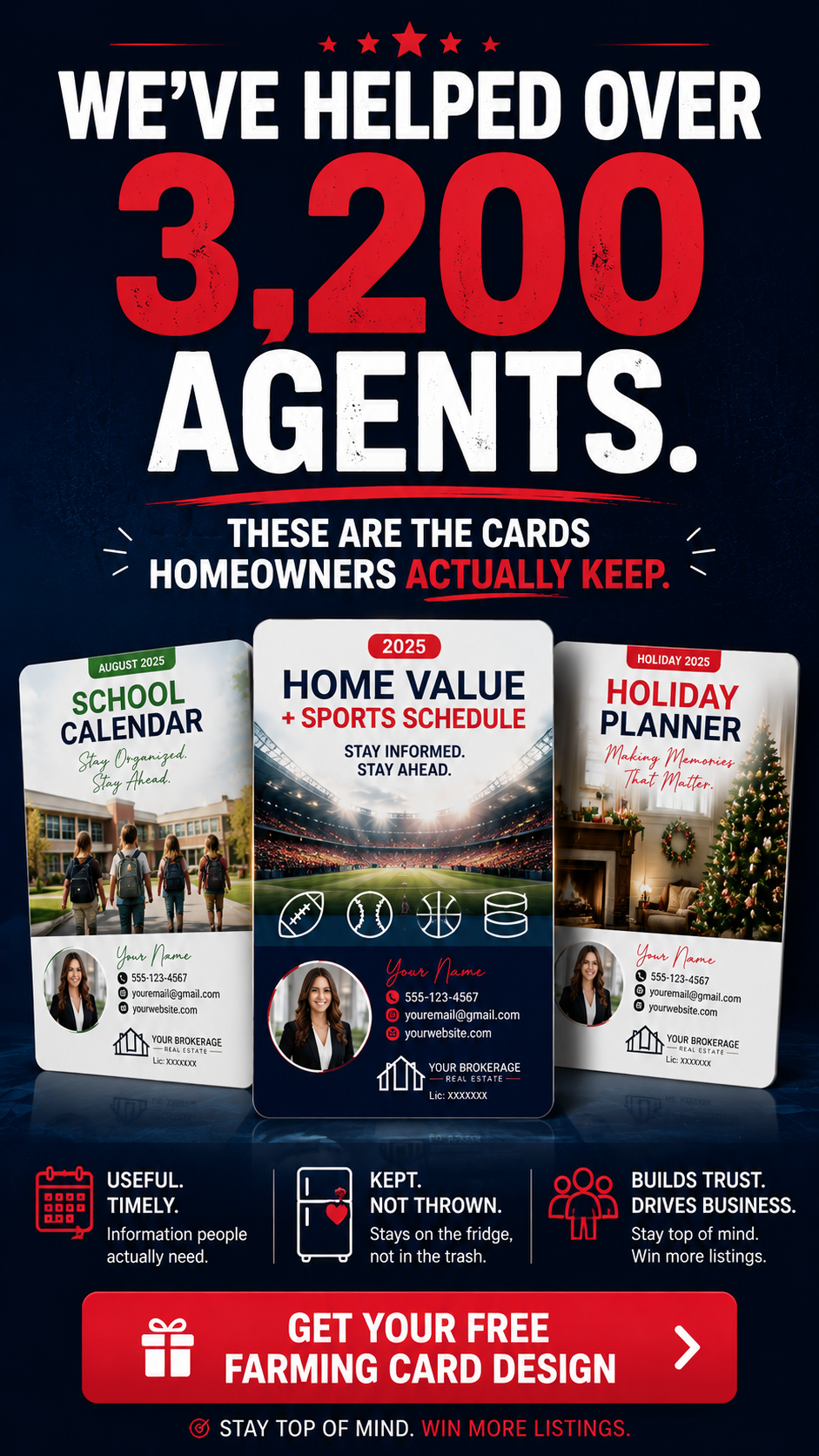
We’ve Helped Over 3,200 Real Estate Agents
Why real estate postcards still work
Every agent’s inbox is crowded. Nobody’s mailbox is. That’s the entire case for direct mail in one sentence.
A homeowner might get 200 emails a week and delete most of them without opening. A postcard sits on the kitchen counter for days. Even if it doesn’t get read carefully the first time, it gets seen, and repetition is what builds the kind of recognition that turns into a listing call six months later.
This is the recognition-to-familiarity-to-trust cycle that real estate farming runs on: people don’t hire the agent with the flashiest one-time ad, they hire the agent whose name they’ve seen enough times that it feels familiar when they’re finally ready to sell.
The problem with most real estate postcards
Walk through a neighborhood’s mail and you’ll see the same postcard format over and over: agent headshot, “Just Listed!” in bold, a house photo, contact info. It’s not wrong, but it’s forgettable. The homeowner has seen a dozen versions of that exact card from a dozen different agents.
A postcard that looks like every other postcard gets sorted with the junk mail, sometimes literally, before the homeowner even registers who sent it.
The keepable postcard: a different approach
The postcards that actually stick around share one trait: they give the homeowner a reason to keep them.
That’s the idea behind putting something genuinely useful on the back of the card instead of more ad copy. A local sports schedule. A QR code that pulls up an instant home value estimate. A quick-reference guide to community resources. Something that earns a spot on the fridge instead of a one-way trip to the trash.
When a postcard survives past the first glance, the agent’s name and face are in that house for weeks instead of seconds. That’s a completely different kind of exposure than a card that gets thrown away on day one.
Types of real estate postcards, and when to use each
Not every postcard should say the same thing. Match the card to the moment:
- Just listed postcards — announce a new listing to the surrounding neighborhood the moment it hits the market, while there’s still buzz to capture.
- Just sold postcards — proof of results, sent right after closing, while the sale is still fresh news in the neighborhood.
- Farming postcards — a consistent, recurring mailer to a chosen geographic area, built for long-term brand recognition rather than a single transaction.
- Market update postcards — local price trends and inventory data that position the agent as the neighborhood expert, not just someone trying to get a listing.
- Open house postcards — timed to go out 5 to 7 days before the event, targeted tightly to the immediate surrounding streets.
Most successful agents run a mix. Just listed and just sold cards react to what’s happening right now. Farming postcards build the long-term brand recognition that makes those reactive cards land with people who already know the name.
What makes a real estate postcard actually work
A handful of things separate the postcards that generate calls from the ones that don’t:
- A single clear message. One listing, one offer, one call to action. Cramming five things onto one card dilutes all of them.
- A specific, local hook. “Just listed on Sunridge Court” beats “New listing available” every time. Specificity signals that this agent actually knows the neighborhood.
- An easy next step. A phone number is fine. A phone number plus a QR code that goes straight to a listing page or a home value tool is better, because it removes friction for the homeowner who’s curious but not ready to call.
- Consistency over time. One postcard rarely moves anyone. The fifth postcard from the same agent, spaced out over months, is usually what finally gets the call.
How much do real estate postcards cost
Pricing depends on the card size, the mailing method, and the list size, but here’s a general range for print-ready, done-for-you real estate postcards:
- Targeted mailing list (minimum 250 addresses): roughly $1.10 to $1.20 per piece, including printing, postage, and delivery.
- EDDM (Every Door Direct Mail) under 2,500 pieces: roughly $0.96 to $1.04 per piece.
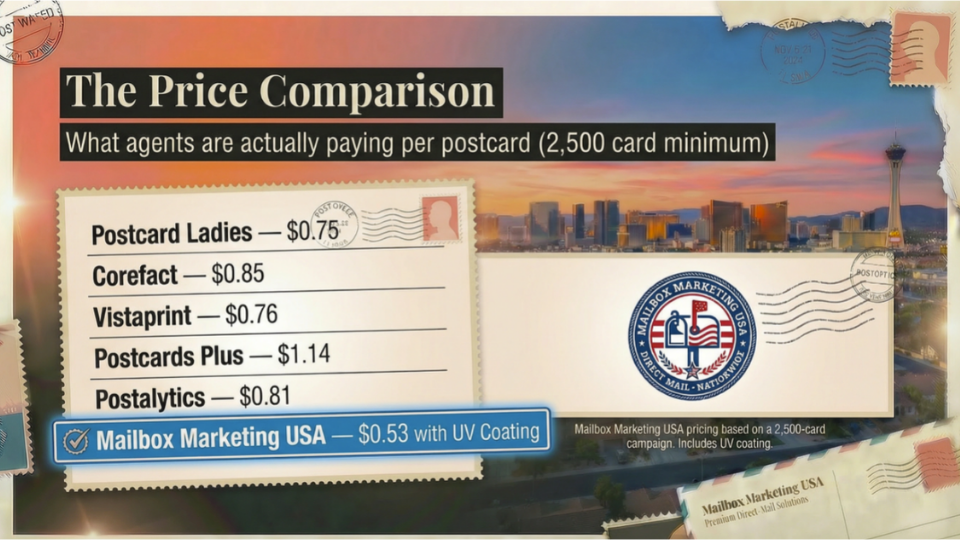
- EDDM at 2,500+ pieces: drops to around $0.53 to $0.56 per piece at scale.
EDDM is usually the more cost-effective route for blanketing an entire farm area without needing a purchased mailing list. Targeted lists make more sense when the agent wants to reach a specific set of homeowners, like a list filtered by home value or ownership length.
Turnaround from design approval to mail delivery typically runs 2 to 3 weeks.
How often should agents mail their farm?
Consistency matters more than volume. A monthly mailer to the same 500 to 1,000 households, sustained over 12 months, does more for brand recognition than one large one-off mailing to 5,000 addresses.
Agents who see the best results from farming usually commit to a fixed cadence, at minimum monthly, and don’t stop after two or three mailings just because the phone hasn’t rung yet. Direct mail farming is a recognition play. It takes repetition before it pays off, and agents who quit early are the ones who conclude “postcards don’t work” when the real issue was stopping too soon.
How Our Pricing Actually Compares
Real numbers, not inflated competitor comparisons made up for a sales page.
Frequently asked questions
Do real estate postcards actually generate leads?
Yes, but rarely from a single mailing. Postcards work best as part of a sustained campaign that builds recognition over months, not a one-time push.
What size postcard should I use?
8.5×5.5 and 6×11 are the most common sizes for real estate mailers. Larger cards stand out more in the mailbox but cost more per piece to print and mail.
Should I use EDDM or a targeted mailing list?
EDDM is cheaper and covers every address on a route, which is ideal for saturating a farm area. A targeted list costs more per piece but lets you filter by specific criteria, like home value or years of ownership, which matters more for niche campaigns than broad farming.
How is a “keepable” postcard different from a regular one?
A regular postcard is pure advertising and gets treated like junk mail. A keepable postcard includes something genuinely useful on the back, like a home value QR code or a local resource guide, giving the homeowner a reason to hold onto it instead of tossing it.
Mailbox Marketing USA has helped over 3,200 real estate agents build their farm with done-for-you postcard campaigns, print-ready design, and the keepable-back concept built in. If you want to see what a campaign looks like for your zip code, get started here.
Ready to Become the Agent Your Neighborhood Thinks of First?
See what a 12-month postcard plan looks like for your farm area — no obligation, no pressure.